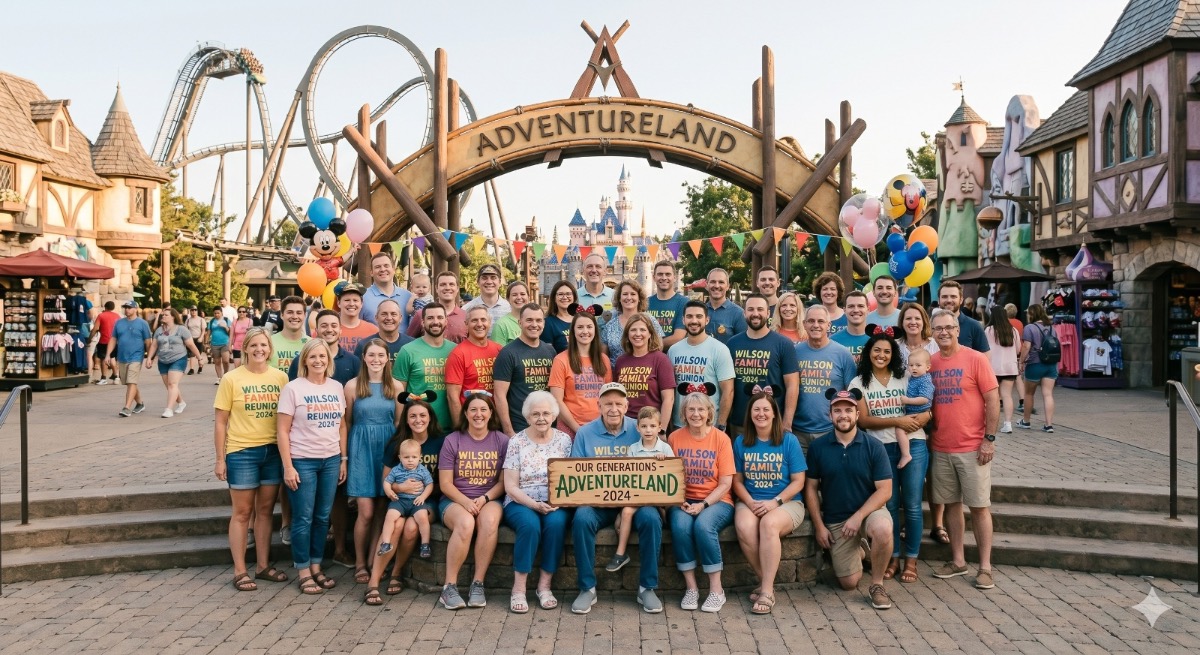
What are some family reunion traditions? Common ones include matching T-shirts, a printed program, a group photo, a banquet, a Sunday worship service, a memorial table and time for elders to tell the family’s story. The Smithsonian’s National Museum of African American History and Culture names the program, group photo and T-shirt as hallmarks of the modern African American reunion. Pick two or three and repeat them every time.
A tradition is anything your family does on purpose, more than once, until people expect it. This guide covers where reunion traditions come from, customs from several cultures, and simple ones any family can start this year. Sources are linked at the end.
01 / WHY THEY MATTER
Why Do Family Reunion Traditions Matter?
Traditions give relatives a reason to come back and a role once they arrive. They pass family history to children who never met the people in the old photos. A Temple University researcher who spent years at Black family reunions found benefits that the families themselves had not recognized, and built an institute to help others plan.
That researcher was Dr. Ione Vargus. According to Temple, she began studying reunions in 1986, collected data at 14 reunions from Boston to the Carolinas, and founded the Family Reunion Institute in 1990. AARP reported that the institute encourages families to share health information at reunions, because some conditions run in families.
02 / AFRICAN AMERICAN REUNIONS
What Are African American Family Reunion Traditions?
The Smithsonian’s National Museum of African American History and Culture traces Black family reunions to the search for relatives separated by slavery. The museum names a printed program, a group photo and a T-shirt as hallmarks of the modern reunion. At these reunions, the museum says, family history is recounted and traditions are taught.
After Emancipation: Putting Families Back Together
The NMAAHC describes how, after emancipation, people searched for lost relatives through newspaper advertisements, letters and word of mouth. Vargus told Temple that “as soon as slavery ended, women and men went about trying to put the family back together,” and that many of those stories are told at reunions. The museum adds that Alex Haley’s Roots (1976) and its 1977 television adaptation revived interest in family history.
The Great Migration: Going Back Home
The University of Alabama at Birmingham’s Institute for Human Rights describes how the Great Migration (1910–1970) moved millions of Black Americans from the rural South to cities, and how reunions became anchors that drew relatives back home. Musicologist Tammy Kernodle, writing for The African American Lectionary, notes that church homecoming grew in importance as migration spread families out.
Traditions You May Recognize
- The reunion T-shirt and logo. The NMAAHC calls brightly colored T-shirts iconic of Black family reunions. One family’s logo it shows uses the adinkra symbol Sankofa, meaning “go back and get it.” See our family reunion T-shirt ideas.
- The banquet and Sunday worship. The Philadelphia Tribune described the King family’s reunion weekend: sightseeing, a picnic, an evening banquet, and relatives of several faiths worshipping together on Sunday morning. The organizer chose a nondenominational church so every faith in the family felt welcome.
- Elders and family history. UAB’s Institute for Human Rights describes elders sharing stories of migration, family land and relatives who raised children not their own.
No two families run a reunion the same way. Ask your elders what your family has always done.
03 / OTHER CULTURES
What Gathering Traditions Come From Other Cultures?
Many cultures have their own ways to gather kin and honor ancestors. Many families who observe Día de los Muertos build ofrendas, many Korean families hold charye rites at Chuseok, many Filipino families greet elders with the mano, and some Jewish and Irish families have formed family clubs and clan gatherings. If one is part of your heritage, bring it to the reunion.
Mexican and Latino: The Ofrenda
The Smithsonian American Art Museum explains that Día de los Muertos is celebrated on November 1 and 2 in Mexico and much of Latin America. Families visit gravesites and build ofrendas: altars with photos of relatives who have died, candles, sweets and favorite foods.
Korean: Charye at Chuseok
According to the Korea Tourism Organization, on the morning of Chuseok family members gather at the family’s head house for charye, a memorial service for their ancestors.
Filipino: The Mano
The USC Digital Folklore Archives records the mano po: a younger relative touches an elder’s hand to their forehead, to show respect and receive a blessing. It makes a natural opening greeting for the oldest relatives.
Jewish: Family Circles
Anthropologist William E. Mitchell studied the family circle, which first appeared among Eastern European Jewish immigrants in New York City in the early 1900s. Routledge, his publisher, describes it as relatives with common ancestors organized like a lodge, with elected officers, dues, meetings and committees. It suits a reunion short of volunteers; see family reunion dues.
Irish and Scottish: Clan Gatherings
FamilySearch notes that clan societies at Highland games help people connect with their family roots. Some Irish clans gather everyone who shares the surname. The O’Sullivan Clan says 1,848 people named O’Sullivan or Sullivan came together to set a world record.
A word of care: a ritual borrowed from a culture that isn’t your family’s can feel like a costume. Use these as prompts to ask what your own grandparents did.

04 / FOR ANY FAMILY
Which Family Reunion Traditions Work for Any Family?
A memorial table, a family history display, recognizing the oldest and youngest relatives, passing down an heirloom, a family recipe book and a group photo in the same spot every time. None needs a big budget, and each one gives a different generation a job to do.
- Memorial table. Photos of relatives who have died since the last reunion, names and years on a card, and a candle. Read the names aloud at the banquet. The Guardian notes that Black family reunions are a time to remember relatives who have passed.
- Family history display. Photo albums, a timeline and a printed family tree, placed near the food where people linger. See our family reunion family tree guide.
- Oldest and youngest. Introduce the eldest relative and the newest baby by name, and take their photo together.
- Heirloom handoff. A family Bible, a quilt or a homemade trophy passes to the next host, who brings it back next time.
- Recipe book. One recipe and its story from each household. AARP described a family that gathered and shared favorite recipes as a keepsake.
- Same-spot photo. Same steps, same pose. Over the years, the photos side by side tell the story.
For games and outings, see our family reunion activities.
“A tradition becomes real the second time. The first time, it’s just a good idea.”
05 / START THIS YEAR
Which Traditions Can You Start at This Year’s Reunion?
Start with one low-effort tradition and one that involves the whole family. A same-spot photo and an elders’ story hour cost nothing. A memorial table costs little more than frames and printing. Leave the recipe book and shirts for a year when you have a volunteer who wants to own them.
| Tradition | Effort | Cost | Who runs it |
|---|---|---|---|
| Group photo in the same spot | Low | Free | The family photographer |
| Elders’ story hour, recorded | Low | Free | A teenager with a phone |
| Oldest and youngest recognition | Low | Low: a card or small gift | The host |
| Heirloom handoff to the next host | Low | Free | The current keeper |
| Memorial table | Low | Low: frames, candle, printing | One contact per branch |
| Family history display | Medium | Low: poster boards, printing | The family historian |
| Family recipe book | Medium | Low to medium: get a print quote | A recipe editor |
| Sunday worship service | Medium | Ask the church | A relative in a local church |
| Reunion T-shirts | Medium | Medium: get a quote per shirt | The shirt committee |
| Banquet with a program | High | Highest: get venue and catering quotes | The banquet committee |
Cost levels are rough guides, not prices. Get quotes and fold shared costs into the dues.
Give Every Branch a Place to Gather Before the Reunion
Chat rooms for each family branch, a shared photo gallery and a free family tree, all on one reunion site.
Launch My Reunion Site06 / KEEPING IT GOING
How Do You Keep a Family Tradition Going?
Give each tradition a named keeper, write it into the program, and announce it in the invitation so relatives arrive ready. Keep a contact list by branch, because families are spread out. Collect photos and stories before the weekend, not during it, so the people who can’t travel still take part.
Name one roster keeper for each grandparent’s line, someone who knows who has moved, married or had a baby.
Sample message to each branch
Subject: Help us honor the family at the [Family Name] Reunion
Hi [Branch] family,
This year we’re setting up a memorial table and a family history display. By [date], please send:
1. A photo, full name and years for anyone in your branch we’ve lost since the last reunion.
2. One old family photo with the names of the people in it.
3. One favorite recipe and the story behind it.
Thank you,
[Your name], [phone]
On AmazingReunion, each family branch has its own real-time chat room, alongside a room for the whole reunion, and relatives upload photos to a shared gallery. The family tree is free with no cap on people, and a relative who accepts an email invitation joins their branch’s chat room automatically. The merchandise store sells reunion shirts and souvenirs in sizes and colors.
Keep Your Family’s Traditions in One Place
Share photos, build the family tree, sell reunion shirts and give every branch its own chat room.
Launch My Reunion SiteFree to start. Includes RSVP, Payments & Photo Sharing.
Frequently Asked Questions
What are some family reunion traditions?
Matching T-shirts, a same-spot group photo, a banquet, a worship service, a memorial table, a story hour with the elders, a recipe book and handing down an heirloom. Pick two or three and repeat them at every reunion.
Why are family reunions important in African American families?
The Smithsonian’s National Museum of African American History and Culture traces the tradition to the search for relatives separated by slavery. Reunions became a way to put families back together, pass down history and stay connected after the Great Migration spread relatives across the country.
How do you start a new family reunion tradition?
Choose one simple tradition, explain it in the invitation, name one person to run it, and repeat it at the next reunion. Write it into the program so the next organizer keeps it.
How do you honor relatives who have died at a family reunion?
Set up a memorial table with photos, names and years, and read the names aloud at the banquet. Ask each branch to send photos ahead of time so nobody is left out.
Sources
- NMAAHC: The Historical Legacy of Black Family Reunions
- Temple University: Family Reunions Create Lasting Bonds
- AARP: 6 Things to Know About Planning a Family Reunion
- UAB Institute for Human Rights: Black Family Reunions as Acts of Resilience
- The African American Lectionary: Homecoming, Cultural Resources (Tammy L. Kernodle, Miami University)
- The Philadelphia Tribune: King Clan Holds Court at Church During Philly Reunion
- The Guardian: The Rich History Behind Black Family Reunions (republished by America’s Black Holocaust Museum)
- Smithsonian American Art Museum: The Transformation of Día de los Muertos in the United States
- VisitKorea: Chuseok, Traditional Korean Holiday of Bountiful Harvest (Korea Tourism Organization)
- USC Digital Folklore Archives: Mano Po
- William E. Mitchell: Kinship, Ethnicity and Voluntary Associations (Routledge)
- FamilySearch: The Highland Games
- O’Sullivan Clan (world-record gathering)
Sources checked October 30, 2026.
Planning a reunion back at the homeplace? Start at the Reunion Planning Guides hub, or follow the month-by-month planning timeline.
Ken O.
Founder of AmazingReunion and veteran reunion organizer who has coordinated 50+ family gatherings across the US.